PHILOSOPHY OF ZEN
Philosophy 430
Fall 2025 Syllabus
Section 001
CRN: 14087
MWF 12:00 — 12:50 PM
Edith Kanakaʻole Hall 111
Hybrid Instruction
Dr. Timothy J. Freeman
The University of Hawai‘i at Hilo
Edith Kanaka‘ole Hall 212
office: 932-7479; cell: 345-5231
freeman@hawaii.edu
Office Hours: MWF 1:00- 1:50 PM
and by appointment
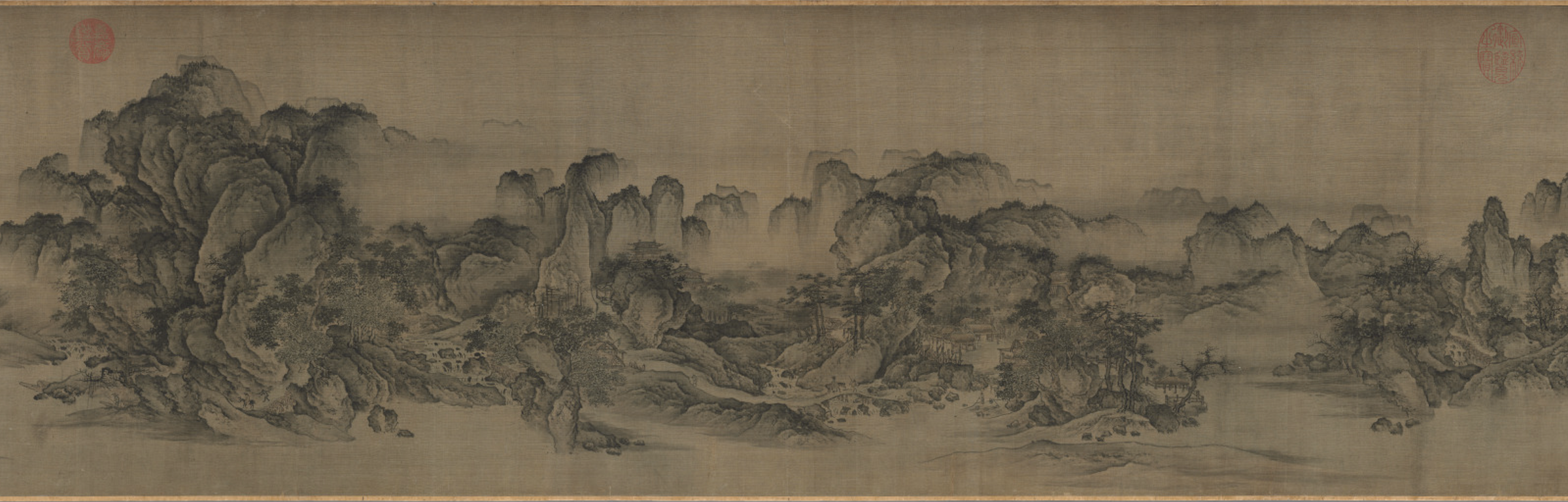
Banner image:
Streams and Mountains without End, 溪山無盡 (detail)
China, late Northern Song dynasty (960-1127) - Jin dynasty (1115-1234)
handscroll, ink and slight color on silk
CATALOGUE COURSE DESCRIPTION
PHIL 430 Philosophy of Zen
Chief philosophical teachings of Zen, its methods and cultural influences. Comparative study of Zen and Western thought. Pre: previous work in philosophy or religious studies, or consent of instructor.
Recommended: PHIL 302. (Same as JPST 430) (Attributes: GAHP, HPP)
REQUIRED TEXTS
Zen Mind. Beginner's Mind, Shunryu Suzuki. Shambhala, 2011.
Zen Pathways: An Introduction to the Philosophy and Practice of Zen Buddhism. Bret W. Davis. Oxford University Press, 2022.
COURSE CONTENT
This course provides an introduction and thorough examination of the philosophy of Zen. Zen is one of the major traditions of Buddhism. Zen flourished in Japan and greatly influenced many aspects of Japanese culture, from architecture, the visual arts, calligraphy, the tea ceremony, Noh drama and Samurai culture. The origins of Zen can be traced to China and India. The word “Zen” is the Japanese translation of the Chinese word “Chan” which was the Chinese translation for the Sanskrit word “Dhyana” that we translate as “meditation.” Thus Zen is, literally, the “Meditation” School of Buddhism. The unique characteristic of Chan or Zen Buddhism is that it developed in China, bringing together Mahāyāna Buddhism from India with Chinese philosophy, especially Daoism. This course will thus review the origins of Zen in Daoism and Indian Buddhism and then follow the development of Chan in China and Zen in Japan. Since coming over to the West from Japan in the 19th and 20th centuries, Zen has also had considerable impact on art, literature and philosophy. At the end of the course we will examine some of the writings of contemporary Zen philosophers.
STUDENT LEARNING OUTCOMES
[Philosophy courses for GE purposes]: (As with all Philosophy courses) Students who successfully complete the course will be able to:
●respond clearly, logically and critically to examination questions and discussion questions about some important philosophical issues relevant to the course;
●read, comprehend, and discuss philosophical texts relevant to the course;
●compose effective written materials that assimilate, synthesize and reflect on course information;
●identify and describe in writing and in class discussion some important aspects of the cultural heritage and contributions of Zen philosophy.
COURSE FORMAT
This course is designated as Hybrid instruction, which means there will be a mixture of face to face and online instruction. Classroom face to face is recommended, but for those who are unable to make it to campus all classes will take place on Zoom and be recorded. Instruction will include lectures, powerpoint presentations, film clips, and discussions.
UH Hilo Designation of Types of Courses
CLASSROOM POLICIES
Students are expected to come to class prepared to discuss the readings. No consumption of food is allowed during class. For those attending on Zoom cameras must be on for attendance to be counted.
GRADING
The final grade will be based on the following:
1) Attendance & classroom participation (10%)
2) Mid-term essay exam (40% each)
3) Final Essay Term Paper (50%)
Grading will be determined according to the following scale:
A 95-100 Excellent
A - 90-94
B + 87-89
B 84-86 Good
B - 80-83
C + 77-79
C 74-76 Satisfactory
C - 70-73 Poor
D 60-70 Failure
F below 60
SUPPORT AVAILABLE FOR STUDENTS
Current, up to date statements regarding ITS, Disability Services, Advising, Academic Integrity, Kilohana Academic Success, Student Conduct, Mental Health, Students of Concern, and Title IX/EEO can be found at the following links:
Short Link
Mobile link
Course Schedule
PART I: PHILOSOPHICAL BACKGROUND
Week 1: Introduction to Zen

Ensō and Calligraphy by Hakuin
Monday, 25 August
Course Introduction & Orientation
Introduction to Zen
Wednesday, 27 August
What is Zen? Recovering the Beginner's Open Mind
Zen Pathways (1-19)
Zen Mind, Beginner's Mind (9-22)
Friday, 29 August
Previewing the Path of Zen
Zen Meditation as a Practice of Clearing the Heart-Mind
How To Practice Zen Meditation
Zen Pathways (20-66)
Week 2: India—The Teachings of the Buddha

Standing Buddha, Gandhara, 3rd c.
Monday, 01 September
*Holiday—Labor Day*
*September 2: Last day to register or add a class, and last day to withdraw from classes without owing tuition*
Wednesday, 03 September
The Teachings of the Buddha
Selections from The Pali Canon
The Buddha's First and Last Lesson
Zen Pathways (67-77)
Friday, 05 September
The Buddha's Strong Medicine
Zen Pathways (78-88)
Week 3: India—Mahayana Buddhism

Bodhisattva Padmapani (Bodhisattva with Lotus)
Ajanta Caves, India, 5th c.
Monday, 08 September
The True Self is Egoless
Zen Pathways (89-102)
Wednesday, 10 September
The Rise of Mahāyāna Buddhism
The Prajñāpāramitā Sūtras
The Diamond Sutra
Friday, 12 September
The Rise of Mahāyāna Buddhism
Celestial Buddhas and Bodhisattvas
We Are One
Zen Pathways (103-116)
*September 12: Last day to exercise Credit/No Credit
and final deadline to apply for Spring 2025 Graduation*
Week 4: India—Mahayana Buddhism

Asanga, Tibetan painting, 19th c.
Monday, 15 September
The Development of Mahāyāna Buddhism
Schools of Indian Buddhism
Three Turnings of the Wheel
Nāgārjuna and the Madhyamaka School
Selections from Mūlamadhyamakakārikā
Chapter 24 Text and Commentary
Chapter 25 Text and Commentary
But We Are Not The Same
Zen Pathways (117-130)
*September 16: Last day to drop a class online without a "W" and last day to receive 50% refund on tuition for complete withdrawals. No refunds will be issued after this date*
Wednesday, 17 September
The Development of Mahāyāna Buddhism
Asaṅga and Vasubandhu and the Yogācāra School
Vasubhandu's Triṃśikā-kārikā ('Thirty-Verses)
An alternate translation and commentary
Friday, 19 September
Who or What is the Buddha?
Zen Pathways (131-142)
Week 5: China—Daoism

Early Spring
Guo Xi, Song Dynasty, 1072
Monday, 22 September
Chinese Philosophy
Key Terms
Daoism
selections from
The Laozi
Wednesday, 24 September
*No Class due to PACT Conference*
Online lecture
Daoism
selections from
The Zhuangzi
Friday, 26 September
*No Class due to PACT Conference*
Online lecture
PART II: Chan Buddhism
Week 6: The Legendary Period of Chan

Bodhidharma Crossing the Yangzi River on a Reed
Painter unknown, Japan, Nanbokucho period (1336-1392)
Monday, 29 September
The Legendary Period of Chan Buddhism
Bodhidharma
Famous Zen Masters
Wednesday, 01 October
The Legendary Period of Chan Buddhism
Bodhidharma
Friday, 03 October
Mind is Buddha
Zen Pathways (143-153)
Mid-Term Essay Exam
(Due Monday, October 20)
Week 7: The Legendary Period of Chan

The Sixth Patriarch Cutting the Bamboo
Liang Kai (c.1140-1210), Song Dynasty (960-1279)
Monday, 06 October
The Legendary Period of Chan Buddhism
Dazu Huike
Wednesday, 08 October
The Legendary Period of Chan Buddhism
Dajian Huineng, the 6th Patriarch (638-713)
selections from
The Platform Sutra
Friday, 10 October
Dying to Live
Zen Pathways (154-173)
Week 8: The Classical Period of Chan

Chan Master Riding a Mule
Anonymous, Song Dynasty (960-1279)
Monday, 13 October
Mazu Daoyi (709-88)
Baizhang Huaihai (720-814)
Zen as Trans-Mysticism
Zen Pathways (174-185)
Wednesday, 15 October
Pangyun (740-808)
Nanquan Puyuan (748-835)
Zhaozhou Congshen (778-897)
Huangbo Xiyun (d. 850)
The Land of the Disappearing Buddha
Friday, 17 October
Engaged Zen
Zen Pathways (186-195)
Week 9: The Classical Period of Chan

Linji (founder of Rinzai Zen)
Japanese painting by Soga Jasoku (fl. c. 1300)
Monday, 20 October
Sectarianism and the Koan
Linji (d. 866)
The Rise of the Linji School (Rinzai Zen)
Gōng'àn (Koan) System
The Dharma of Karma
Zen Pathways (196-208)
Wednesday, 22 October
Sectarianism and the Koan
Rise of Soto Zen
Dongshan Liangjie
Caoshan Benji (840-901)
Friday, 24 October
Zen and Morality
Zen Pathways (209-221)
PART III: ZEN BUDDHISM
Week 10: The Rise of Zen

Dōgen Watching the Moon
Self-portrait, Hōkyōji monastery, Fukui prefecture, c. 1250
Monday, 27 October
Dōgen (1200-1253)
Selections from the Shōbōgenzo:
The Record of Things Heard
One Bright Pearl
Wednesday, 29 October
From Shōbōgenzo:
The Issue at Hand
The Nature of Things
Birth and Death
Friday, 31 October
Being in the Zone of Zen
Zen Pathways (222-235)
Week 11: The Mountains and Waters Sutra

Streams and Mountains without End (detail)
China, late Northern Song dynasty (960-1127).
Handscroll, ink and slight color on silk.
Monday, 03 November
*November 3: Last day to drop a class online with a "W"*
Wednesday, 05 November
More from the Mountains and Waters Sutra
Friday, 07 November
Zen Lessons from Nature
Zen Pathways (236-247)
Week 12: The Development of Zen

Monday, 10 November
The Muromachi Period (1336-1573)
Musō Soseki (1275-1351)
Dream Conversations on Buddhism and Zen
Ikkyū Sōjun (1394-1481)
Film:
Zen and the Arts
Zen and Art
Zen Pathways (248-260)
Wednesday, 12 November
The Edo Period or The Tokugawa Period (1603-1868)
Yin Yuan (1592-1673)
Bashō Matsuo (1644-1694)
Bankei Yōtaku (1622-1693)
Hakuin Ekaku (1686-1769)
Rinzai Zen
Satori: Zen Enlightenment
Friday, 14 November
Zen and Language
Zen Pathways (261-274)
PART IV: CONTEMPORARY ZEN
Week 13: Zen Mind—Beginner's Mind

Monday, 17 November
Shunryu Suzuki
Zen Mind, Beginner’s Mind
Right Practice
Right Attitude
Wednesday, 19 November
Shunryu Suzuki
Zen Mind, Beginner’s Mind
Right Understanding
Epilogue
Friday, 21 November
Between Zen and Philosophy
Zen Pathways (275-289)
Week 14: Engaged Buddhism

Monday, 24 November
Robert Aitken
Selections from
The Mind of Clover
Thinking Like a Mountain, Aldo Leopold
Remembering Aitken Roshi
Wednesday, 26 November
Gary Snyder
Selections from Various Writings
The Practice of the Wild
Gary Snyder film
Albert Saijo
It's Zensational
Sōtō and Rinzai Zen Practice
Zen Pathways (290-301)
Friday, 28 November
*Non-Instructional Day*
Week 15: Engaged Buddhism

Monday, 01 December
Wednesday, 03 December
*May 3: Last day to completely withdraw from all UH Hilo classes with a "W"*
Friday, 05 December
Death and Rebirth
Zen Pathways (302-319)
Week 16: Reviewing the Path of Zen

Oxherding Pictures, No. 10:
Entering the Marketplace
Tenshō Shūbun, Japan, 15th century.
Ink and light colours on paper handscroll.
Museum of Shokoku-ji Temple
Kyoto
Monday, 08 December
The Ten Oxherding Pictures
Zen Pathways (320-338)
Wednesday, 10 December
Discussion Forum
Final Essay Exam
(Due Monday, December 15, 1:50 PM)
Final Exam
Monday, 15 December (11:50 AM—1:50 PM)
**Schedule is subject to revision**